How did Anglicanism become part of British identity?
How Did Anglicanism Become Part of British Identity?
Understanding how history, worship and institutions continue to shape British society
Can a religious tradition remain influential even when fewer people actively identify with it? This question is particularly relevant in contemporary Britain, where religious participation has declined while Anglicanism continues to occupy a distinctive place in national life. Woodhead (2016) argues that secularisation has reduced religious practice without completely erasing Christianity's cultural influence on British society. This perspective helps explain why Anglicanism remains relevant today. Rather than functioning solely as a system of beliefs, it continues to shape Britain's constitutional traditions, national symbols and collective identity, demonstrating that its significance extends far beyond individual religious commitment.
The origins of Anglicanism can be traced to the English Reformation under Henry VIII, yet its importance lies not only in this historical event but also in the institutions and national traditions that it established. Marshall (2009) explains that the English Reformation should be understood as a gradual historical process rather than a single political event, since it transformed the relationship between religion, political authority and society over several generations. This interpretation highlights that Henry VIII's break with Rome was more than a dynastic decision; it marked the beginning of a new understanding of national sovereignty in which the English Crown assumed religious authority. Consequently, the creation of the Church of England became a defining moment in the construction of British political and cultural identity.
The historical consequences of the Reformation continue to shape Britain today. Ryrie (2017) argues that British national identity has developed through the close relationship between religion, monarchy and historical memory, allowing Anglicanism to remain visible even in an increasingly secular society. This explains why the Church of England still occupies a distinctive constitutional position and why royal ceremonies, parliamentary traditions and national commemorations continue to reflect its historical legacy. Therefore, Anglicanism should be understood not only as a religious denomination but also as a cultural framework through which historical memory, political traditions and national identity continue to interact. Its enduring visibility in public life demonstrates that its significance extends beyond religious belief, remaining deeply embedded in Britain's understanding of itself as a nation.
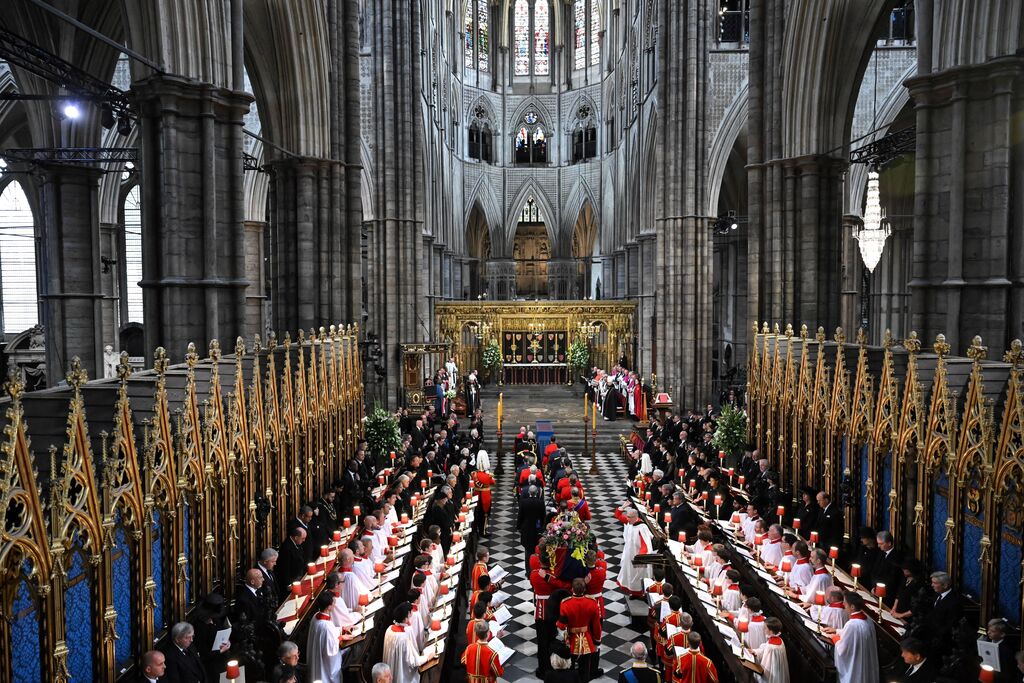
Note. The funeral of Queen Elizabeth II took place at Westminster Abbey in September 2022, illustrating how Anglican worship and national ceremony remain connected to British collective memory. Adapted from The Vietnam Courier News, 2023. https://lecourrier.vn/labbaye-de-westminster-un-millenaire-dune-histoire-etroitement-liee-a-la-royaute/1179588.html
Building on this historical legacy, Anglicanism continues to shape British identity through its forms of worship and shared religious traditions. One of the clearest examples is the Book of Common Prayer, whose significance extends beyond its role as a liturgical text. As Logan (2026) explains, the Prayer Book preserves the Church's historical memory while communicating Anglican theology through common forms of worship shared across generations.
This continuity reflects the principle lex orandi, lex credendi, the idea that belief is expressed and sustained through communal prayer, making worship not only an act of faith but also a means of preserving collective identity (Pérez, 2026). Although Anglican liturgy has adapted to contemporary social and linguistic realities, its essential structure remains recognizable, demonstrating how tradition can evolve without losing its historical foundations (Grundy, 2012). In this sense, worship functions as a living expression of Britain's religious and cultural heritage rather than as a simple repetition of historical practices.
This shared identity also extends well beyond religious services. As Erlandson (2024) argues, Anglican identity is sustained through interconnected historical, practical and institutional dimensions, allowing it to remain visible within contemporary society despite increasing diversity. English cathedrals illustrate this continuity particularly well. Beyond being places of worship, they have become civic spaces where education, cultural heritage, volunteering and community engagement converge, enabling visitors of all religious backgrounds to connect with local history and public life (Lapshynov & Mladin, 2026).
Significantly, 94% of visitors, including those with no religious affiliation, identified their cathedral as a hub for community life, while more than 95% reported feeling connected to local history and tradition (Lapshynov & Mladin, 2026). Likewise, recent evidence shows that cathedrals increasingly combine spiritual, educational and civic roles, reinforcing their relevance beyond religious practice (Mbah, 2026). Therefore, Anglicanism remains significant in contemporary Britain not simply because it emerged from a pivotal moment in the nation's history, but because its influence continues to be expressed through shared forms of worship, enduring institutions and collective cultural memory.
As this discussion has shown, Anglicanism has become part of British identity by connecting historical traditions with present-day social life, allowing individuals to engage with a common heritage regardless of their level of religious commitment. Its continuing relevance therefore lies not only in what it has preserved from the past, but also in its ability to provide a sense of continuity, belonging and national identity within an increasingly diverse society.
References
Erlandson, C. (2024). The issue of Anglican identity. Cranmer Theological Journal, 1, 3–17.
https://www.researchgate.net/publication/377574176_The_Issue_of_Anglican_Identity
Grundy, P. T. (2012, May 2). Anglican world marks 350 years of the Book of Common Prayer. Episcopal News Service.
https://www.episcopalnewsservice.org/2012/05/02/anglican-world-marks-350-years-of-the-book-of-common-prayer/
Lapshynov, G., & Mladin, N. (2026, May 18). Living stones: English cathedrals as sacred spaces in changing times. Theos Think Tank.
https://www.theosthinktank.co.uk/research/2026/05/18/living-stones-english-cathedrals-as-sacred-spaces-in-changing-times
Logan, C. (2026, April 28). Book of Common Prayer draws Gen Z to the Anglican-Episcopal tradition. Episcopal News Service.
https://episcopalnewsservice.org/2026/04/28/book-of-common-prayer-draws-gen-z-to-the-anglican-episcopal-tradition/
Mbah, O. (2026, May 19). England's cathedrals remain vital civic and spiritual "beacons" despite mounting pressures: Report. Christian Today.
https://www.christiantoday.com/news/englands-cathedrals-remain-vital-civic-and-spiritual-beacons-despite-mounting-pressures-report
Marshall, P. (2009). (Re)defining the English Reformation. Journal of British Studies, 48(3), 564–586.
https://wrap.warwick.ac.uk/id/eprint/97/1/WRAP_Marshall_redefining.pdf
Pérez, G. G. (2026, April 9). Anglicanism: Has it surrendered to culture? BITE Project.
https://biteproject.com/anglicanismo-se-ha-rendido-ante-la-cultura/
Ryrie, A. (2017). Prologue: When did the English Reformation happen? A historiographical curiosity and its interpretative consequences. Études Épistémè, 32.
https://doi.org/10.4000/episteme.1845
Woodhead, L. (2016). The rise of "no religion" in Britain: The emergence of a new cultural majority. Journal of the British Academy, 4, 245–261.
https://www.thebritishacademy.ac.uk/documents/1043/11_Woodhead_1825.pdf
Comments
Post a Comment