Crown, Power and Faith: The Origins of Anglicanism
Royal Authority and Religious Change: The Formation of Anglicanism
Political Power and the English Reformation
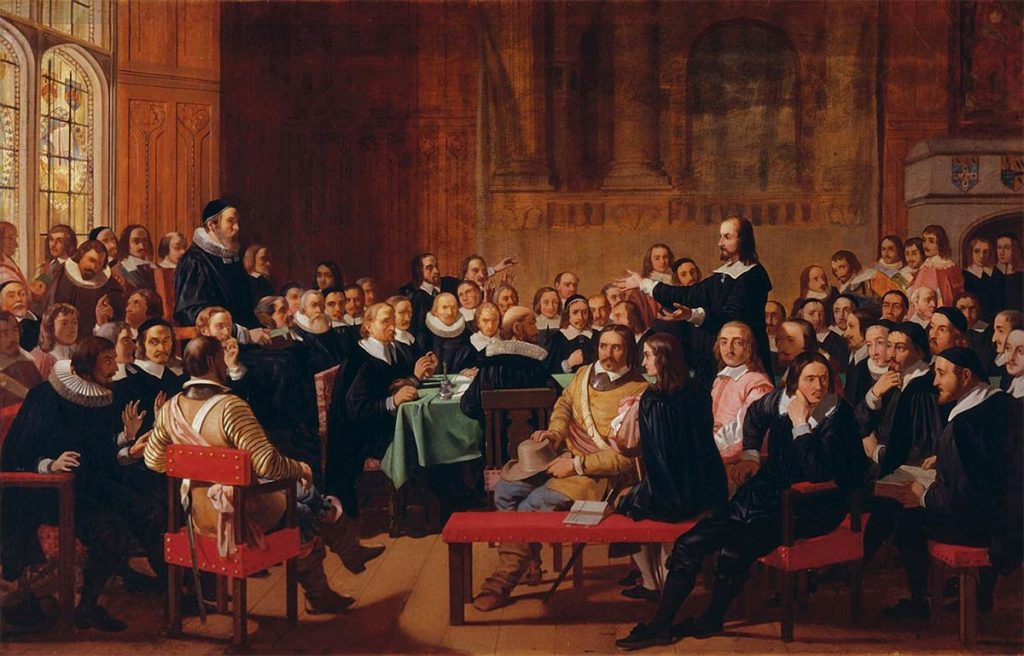
Note. Adapted from Representation of the Westminster Assembly, by Perez. G, 2021, Bite Project (https://biteproject.com/anglicanismo/).
Anglicanism, known as a distinct tradition of Christianity, was formed when the Church of England shifted from being dependent on the Pope to being under the authority of the king, Henry VIII. This transformation not only impacted the religious sphere but also redefined the structure of political power in England (Sachs, 2026). Over time, this tradition evolved through the interaction of Catholic traditions and the dynamics of the English Reformation, becoming the result of a broader political and social process. In this sense, this post explores the historical foundations of Anglicanism and its development, in order to understand its relevance within British society.
Primarily, it should be noted that Anglicanism originated during the English Reformation of the sixteenth century, a process that fundamentally reshaped the organization of the Church of England. In this context, King Henry VIII rejected the authority of the Pope, motivated not only by growing resistance to papal power but also by his intention to consolidate control over religious affairs within the kingdom (Arija, 2022).
As indicated by Kirby (2006), a key turning point in this process was the king’s request to annul his marriage to Catherine of Aragon, which the Pope ultimately refused. Although this may appear to have been a personal matter, it triggered a broader conflict over authority within the Church, revealing deeper tensions between royal power and papal influence.
This conflict culminated in the Act of Supremacy of 1534, through which the monarch was established as the supreme authority of the Church of England, formally breaking with Rome and laying the institutional foundations of Anglicanism (Richardson, 2022).
Building upon this rupture, the English Reformation generated profound transformations that extended far beyond religion into the social and political fabric of England. As noted by Marshall (2017), these changes produced deep divisions within society, shaping new forms of religious identity and contributing to the emergence of pluralism. In this context, religious affiliation gradually became linked not only to institutional belonging, but also to personal belief and social differentiation.
At the same time, the development of Anglicanism was closely tied to political interest. The establishment of the Church of England reflected the consolidation of royal authority over religious structures, positioning the monarch at the center of ecclesiastical power (Quispe, 2019). This dynamic illustrates what Aranguren (1948) defines as the “politicization of religion”, in which religious institutions are shaped by state priorities rather than purely theological concerns. As a result, Anglicanism emerged as a flexible and adaptive tradition, capable of responding to shifting historical contexts.
Over time, this adaptability facilitated its expansion beyond England. Through missionary activity and imperial networks, Anglicanism developed into a global communion characterized by decentralized authority and shared doctrinal foundations (Sachs, 2026). Its identity as a “middle way” between Catholicism and Protestantism further reinforced its ability to integrate diverse perspectives while maintaining institutional continuity.
These historical dynamics continue to resonate in contemporary British society. The enduring relationship between Church and State, along with the Church’s presence in political and public institutions, reflects how Anglicanism remains embedded in the cultural and institutional identity of the United Kingdom (Church of England, n.d.). In this way, what began as a political and religious rupture evolved into a defining element of national identity, bridging past transformations with present-day realities.
Note. Adapted from What Is Anglicanism? Our Beliefs, by Anglican Diocese of Pittsburgh, 2024, YouTube (https://youtu.be/6NUD21eW8t0).
References:
Aranguren, J. L. L. (1948). Religión y Política: El anglicanismo. Revista de estudios políticos, 37, 125–145. https://dialnet.unirioja.es/servlet/articulo?codigo=2127686
Arija, L. (2022). The History of Anglicanism: Origin, Changes and Consequences. [Tesis de maestría, Universidad de Valladolid] Repositorio Uvadoc. https://uvadoc.uva.es/bitstream/handle/10324/58452/TFG_F_2022_033.pdf?sequence=1
Kirby, T. (2006). Lay Supremacy: Reform of the canon law of England from Henry VIII to Elizabeth I (1529-1571). Reformation & Renaissance Review, 8(3), 349–370. https://doi.org/10.1558/rrr.v8i3.349
Marshall, P. (2017, mayo 24). The English reformation: Was Henry VIII the founder of Roman Catholicism? Yale University Press. https://yalebooks.yale.edu/2017/05/24/the-english-reformation-was-henry-viii-the-founder-of-roman-catholicism/
Quispe, F. C. (2019). Enrique VIII y el anglicanismo: Contexto económico, social y político. Contradicciones entre los Tudor. María y Elizabeth. UNIVERSIDAD NACIONAL DE EDUCACIÓN Enrique Guzmán y Valle. https://repositorio.une.edu.pe/server/api/core/bitstreams/3f046d2f-6c42-4a8e-9971-ad1897e5777e/content#page=8.36
Richardson, G. (2022). The ‘diplomatic masculinity’ of Henry VIII. The International History Review, 44(5), 952–969. https://doi.org/10.1080/07075332.2022.2046130
Sachs, W. (2026, 3 de mayo). Anglicanism. Britannica. https://www.britannica.com/topic/Anglicanism
The Church of England. (n.d.). History of the Church of England. Churchofengland.org. https://www.churchofengland.org/about/history-church-england
Comments
Post a Comment